.svg)

Content marketing trends 2026: what changed (and what not)
Content marketing in 2026 looks different from two years ago. How content gets found, how it gets made, and what readers trust have all moved at once.

What makes a good brand book?
Sed viverra ipsum nunc aliquet bibendum enim facilisis gravida. Diam phasellus vestibulum lorem sed risus ultricies. Magna sit amet purus gravida quis blandit. Arcu cursus vitae congue mauris. Nunc mattis enim ut tellus elementum sagittis vitae et leo. Semper risus in hendrerit gravida rutrum quisque non. At urna condimentum mattis pellentesque id nibh tortor. A erat nam at lectus urna duis convallis convallis tellus. Sit amet mauris commodo quis imperdiet massa. Vitae congue eu consequat ac felis.
- Lorem ipsum dolor sit amet consectetur hendrerit gravida rutrum.
- A erat nam at lectus urna duis convallis convallis tellus.
- Arcu cursus vitae congue mauris mattis enim ut tellus elementum sagittis vitae et leo.
- Magna sit amet purus gravida quis blandit cursus congue mauris mattis enim.
How to create a good brand book?
Vestibulum lorem sed risus ultricies. Magna sit amet purus gravida quis blandit. Arcu cursus vitae congue mauris. Nunc mattis enim ut tellus elementum sagittis vitae et leo. Semper risus in hendrerit gravida rutrum quisque non.
Important elements of a good design brand book
Eget aliquet nibh praesent tristique magna sit amet purus. Consequat id porta nibh venenatis cras sed felis. Nisl rhoncus mattis rhoncus urna neque viverra justo nec. Habitant morbi tristique senectus et netus et malesuada fames ac. Et tortor consequat id porta nibh venenatis cras sed felis. Fringilla est ullamcorper eget nulla facilisi. Mi sit amet mauris commodo quis. Eget arcu dictum varius duis at consectetur lorem.Venenatis cras sed felis eget velit
- Magna eget est lorem ipsum dolor.
- Enim lobortis scelerisque fermentum dui. Fringilla ut morbi tincidunt augue.
- Nascetur ridiculus mus mauris vitae.
- Egestas sed tempus urna et pharetra pharetra massa massa ultricies.
What brand book references can I use?
Mattis molestie a iaculis at. Volutpat est velit egestas dui id. Suspendisse potenti nullam ac tortor vitae purus faucibus. Aliquet nibh praesent tristique magna sit amet purus gravida. Volutpat blandit aliquam etiam erat velit scelerisque in dictum. Potenti nullam ac tortor vitae purus faucibus ornare suspendisse sed. Aliquet bibendum enim facilisis gravida neque convallis. Malesuada nunc vel risus commodo viverra maecenas. Varius sit amet mattis vulputate enim.
“Arcu cursus vitae congue mauris mattis enim ut tellus elementum sagittis vitae et leo nullam ac tortor”
A brand book can always keep evolving
Egestas quis feugiat urna, tincidunt ut sem sit in ipsum ullamcorper etiam varius turpis tincidunt potenti amet id vel, massa purus arcu lectus scelerisque quisque velit cursus et tortor vel viverra iaculis ornare feugiat ut cursus feugiat est massa, blandit quam vulputate facilisis arcu neque volutpat libero sollicitudin sed ac cursus nulla in dui imperdiet eu non massa pretium at pulvinar tortor sollicitudin et convallis senectus turpis massa bibendum ornare commodo eu scelerisque tristique justo porttitor elit morbi scelerisque facilisis
TL;DR
- Buyers now start research inside AI chatbots like ChatGPT and Perplexity, not Google.
- GEO (Generative Engine Optimization) became essential for getting quoted in AI answers.
- Producing more AI content stopped working once everyone could generate the same surface-level posts.
- Winning teams build marketing fundamentals and a human point of view, not prompt tricks.
- Trust is the scarce resource, and specificity signals credibility better than polish.
- Named authors, concrete examples, and honest caveats separate trusted content from filler.
- Restructure one high-traffic page for AI search and add human specificity to start.
Two things moved at once this year: how your content gets found, and how readers decide whether to trust it. Below I am sharing my personal perspective on what changed, and what I would do about it.
How are buyers finding content in 2026?
Your buyers are starting their research inside AI chatbots now, not search engines. A large share of B2B buyers open ChatGPT or Perplexity and ask for recommendations before they ever type a query into Google.
Here is why that matters. It breaks the old SEO model completely. AI engines build one answer from several sources instead of handing back a list of blue links, so if your content is not structured for extraction, it never makes it into the answer at all. It is just invisible.
That is why Generative Engine Optimization (GEO) went from a nice experiment to table stakes this year.
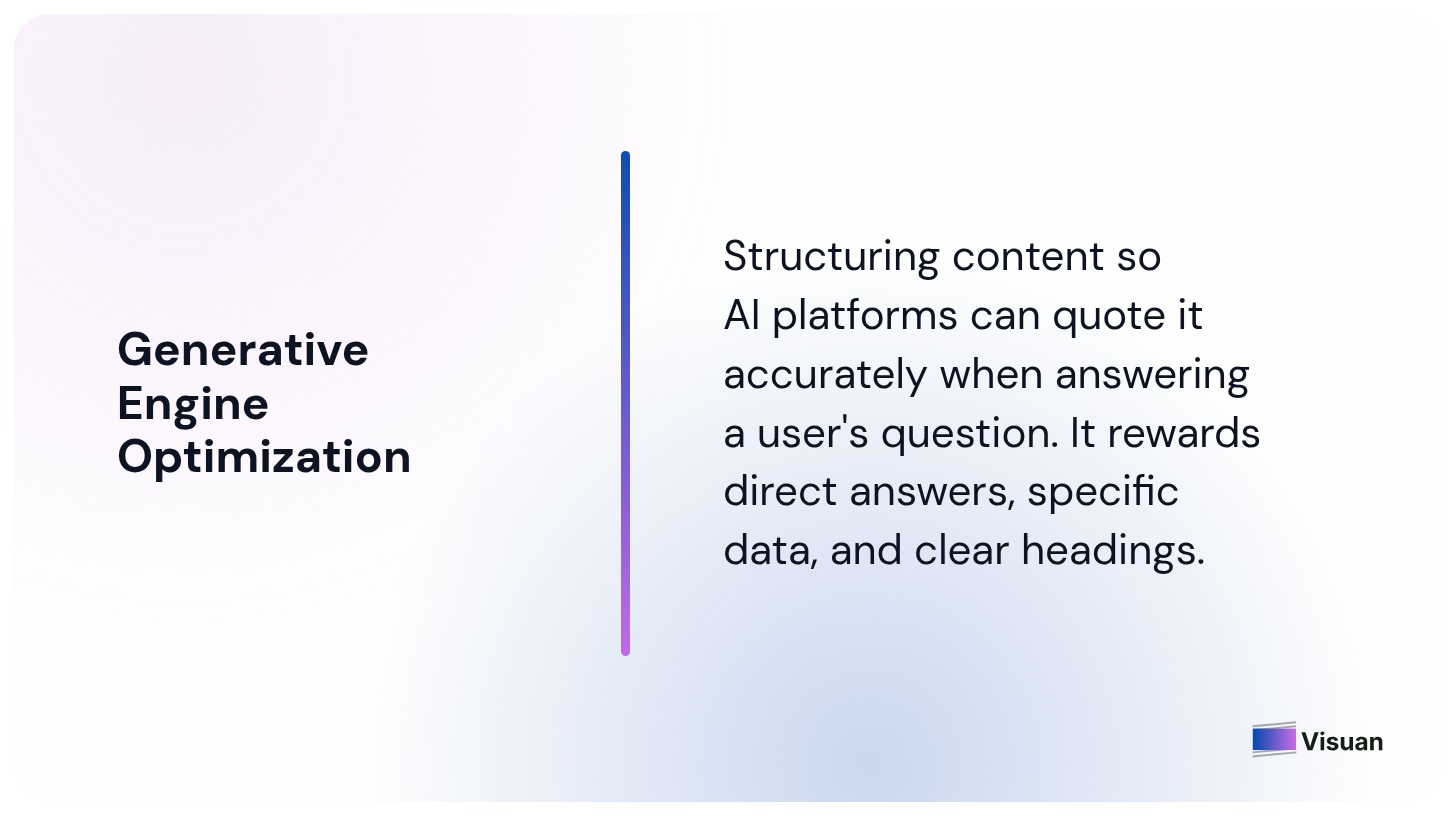
GEO is the practice of structuring content so AI platforms can quote it accurately when they answer a question. It rewards direct answers placed high in a section and specific data points. It also rewards clearly defined entities and headings phrased the way real people ask questions.
Does producing more AI content still work?
No. Producing more content with AI stopped working on its own. The volume play is dead, because everyone can now spin up the same surface-level post in seconds, and readers have gotten very good at scrolling straight past them.
The Content Marketing Institute's 2026 B2B research, based on 1,015 B2B marketers, found the teams winning this year are the ones building marketing fundamentals rather than chasing prompts or algorithms. That tracks with what I keep seeing. AI accelerates production, sure. It does not hand you a point of view, and a point of view is the whole reason anyone reads to the end.
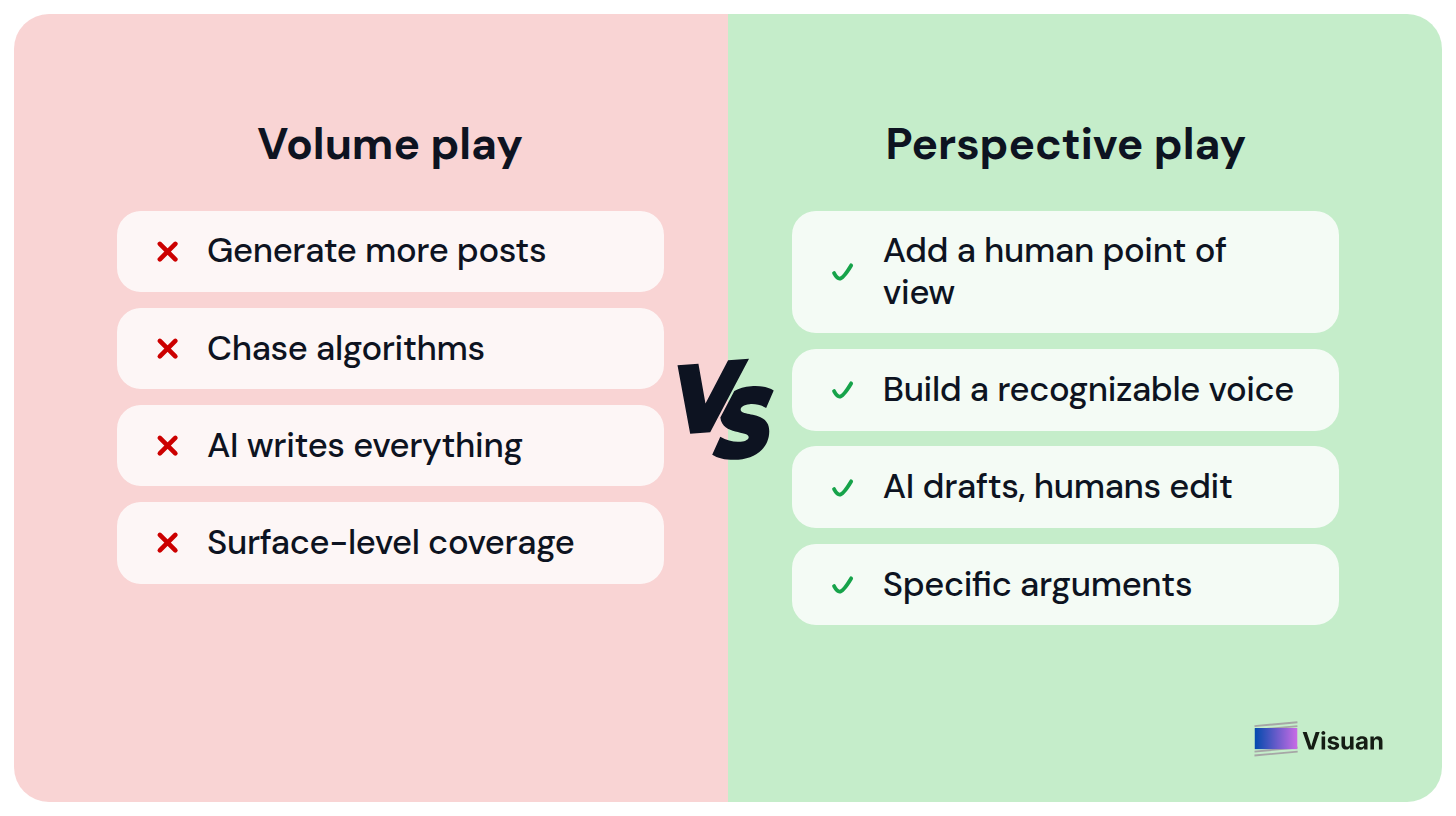
So use AI for the mechanical stuff, the outlines and the rough first drafts, and keep the perspective and the editing firmly human. AI sets the floor for quality. Your thinking sets the ceiling.
Why does trust matter more than ever?
Trust is the scarce resource now, because synthetic content is everywhere you look. When anyone can generate a polished article in seconds, polish stops meaning anything. Specificity is what signals credibility instead.
A few things separate content readers trust from filler:
- Named authors with real roles and visible expertise, rather than a faceless "Content Team" byline.
- Concrete examples pulled from real client work, pilots, or the odd failure.
- Honest admissions of where an approach does not apply.
Content that never risks being wrong rarely reads as credible, and honestly that is the trap most brands fall into. The ones that used AI to flood every channel without a clear voice just diluted themselves. A strong, recognisable voice is a genuine competitive asset in 2026.

What should you do about it?
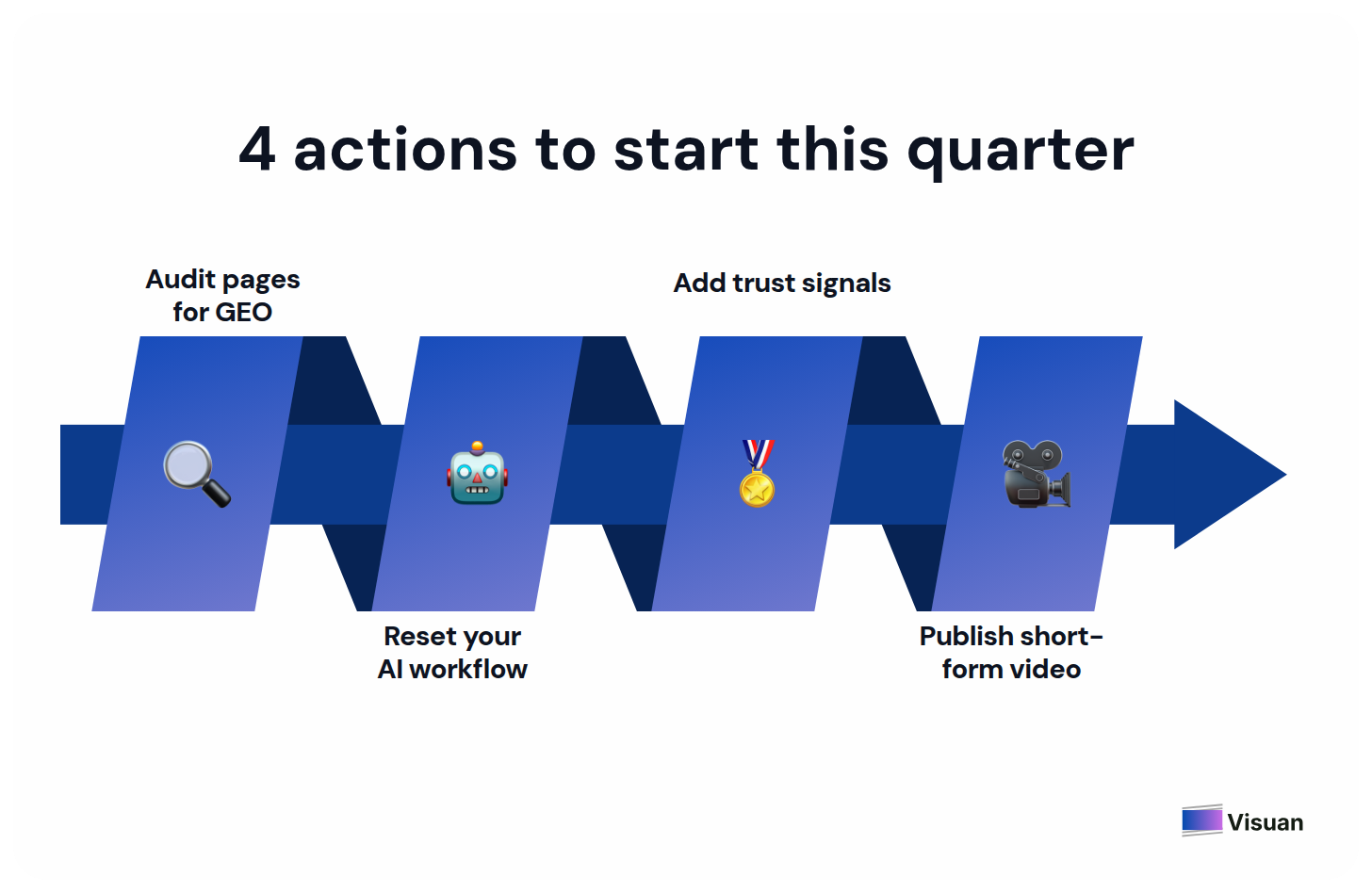
The trends point to a few things you can start this quarter:
- Audit your top pages for GEO. Open each major section with a direct answer under 30 words, add at least one specific statistic per section, and define your product and category on first mention.
- Reset your AI workflow. Draft and repurpose with AI, then add a human point of view and a real example before anything ships.
- Build trust signals into every piece. Named authors, specific outcomes with numbers, honest caveats.
- Put a face on your expertise with short-form video that tackles one real problem at a time.
💡 Pro tip:
When you cite a statistic, attribute it to a named source with the year. AI engines weight credible, attributable claims more heavily, and that attribution is part of how you get cited back.
The bottom line
The teams that win in 2026 are the ones producing content AI engines can quote and readers can trust, carrying a perspective no model could generate on its own. Pick one high-traffic page, restructure it for AI search, and add the human specificity that filler content will never have. Start there.
All of this raises a production problem, though. A point of view takes time to develop, and real examples take time to gather. Then there is video, which has to be shot and edited on top of everything else. The mechanical work still has to happen, and it fights for the same hours you need for the thinking that actually gets read.
That is the gap Visuan closes. It handles the visual production layer, blog graphics and LinkedIn carousels, so the hours you claw back go straight into perspective and specificity. You write the argument. Visuan turns it into the visuals that carry it across the feeds where your buyers now start looking.
FAQ
Why does the old content playbook of volume plus keywords no longer work?
Everyone can now generate the same surface-level post in seconds, so volume alone fails. Readers scroll past generic content, and AI search engines build answers from structured sources rather than long keyword-stuffed lists.
What is Generative Engine Optimization (GEO)?
GEO is the practice of structuring content so AI platforms can quote it accurately when answering a question. It rewards direct answers placed high in a section, specific data points, clearly defined entities, and headings phrased the way people actually ask.
How are B2B buyers finding content in 2026?
A large share of B2B buyers open AI chatbots like ChatGPT or Perplexity and ask for recommendations before ever searching Google. AI engines then build one answer from several sources instead of returning a list of links.
Should I stop using AI to create content?
No. Use AI for the mechanical work like outlines and rough first drafts, then keep the perspective and editing human. AI sets the floor for quality, while your thinking sets the ceiling.
Why does trust matter more than ever in 2026?
Synthetic content is everywhere, so polish no longer signals credibility. Specificity does. Trust has become the scarce resource, and a strong recognisable voice is a real competitive asset.
What separates content readers trust from filler?
Named authors with real roles and visible expertise, concrete examples from real client work or pilots, and honest admissions of where an approach does not apply.
What should I do first to adapt to these trends?
Pick one high-traffic page and restructure it for AI search. Open each section with a direct answer under 30 words, add a specific statistic per section, define your product on first mention, and layer in human examples.
.png)


Subscribe to the Visuan newsletter
Get product updates and content tips, straight to your inbox.